SDOF - Displacement Transmissibility
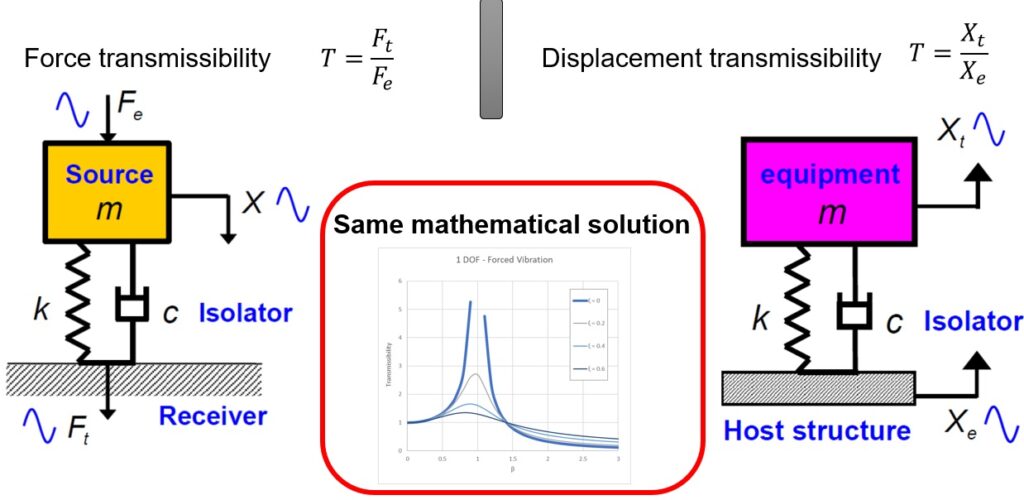
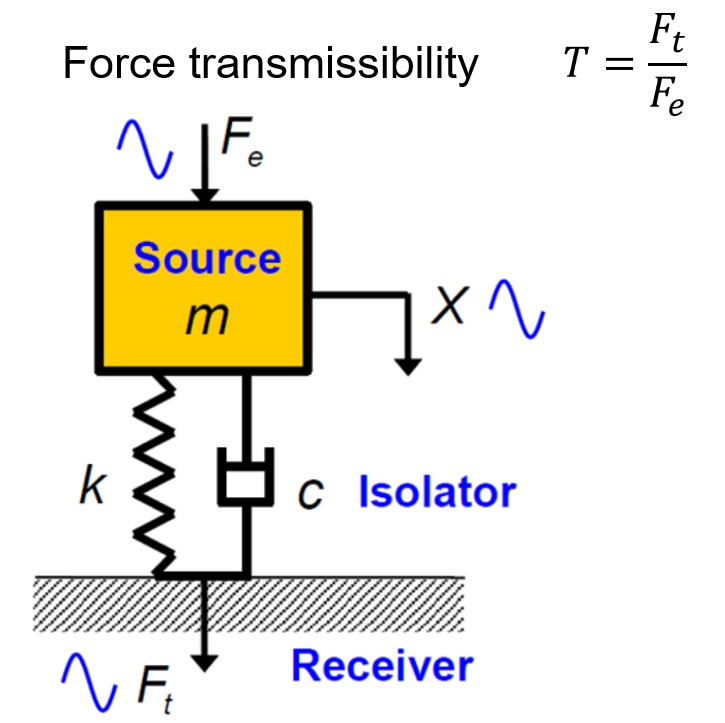
In the previous post, the concept of force transmissibility was introduced, an essential parameter in vibration problems where the primary objective is to minimize the force transmitted amplitude Ft to the foundation by an SDOF system subjected to an exciting harmonic force of amplitude Fe, as shown in the figure alongside.
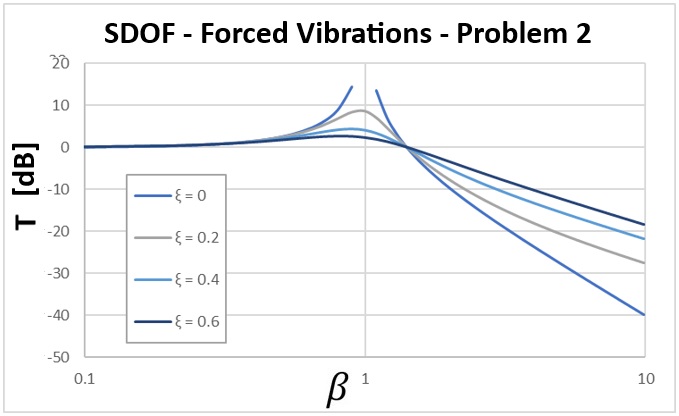
We have seen how the force transmissibility curves present a maximum for a value of approximately one of the frequency ratio β, the ratio between the exciting frequency and the natural frequency of the SDOF system.
Attenuation is obtained for high values of the frequency ratio β, the greater the lower the damping factor 𝜁.
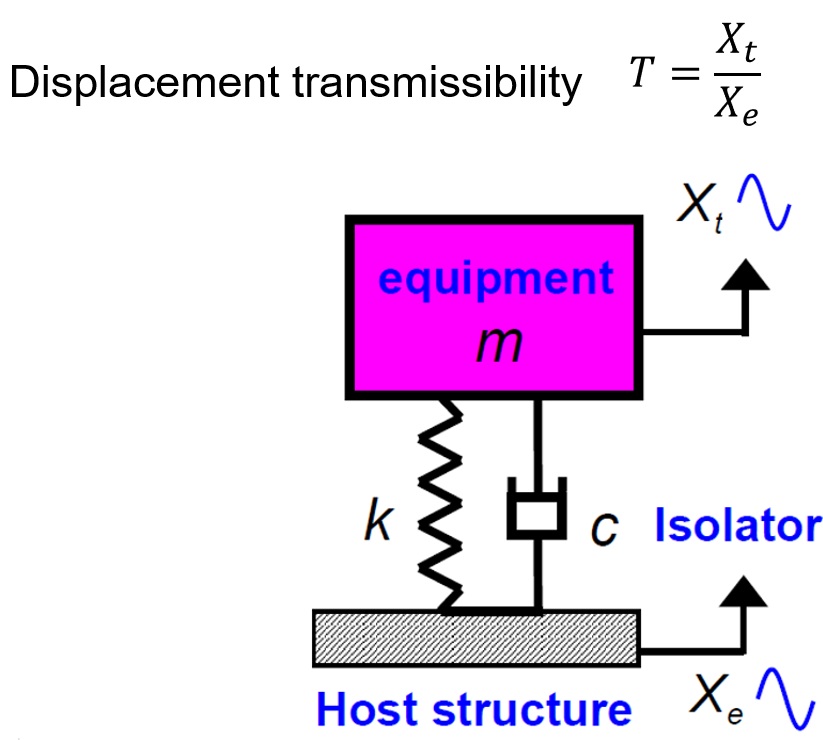
In Vibration Mechanics, a second problem of transmissibility exists. Consider again a SDOF system, this time connected to a foundation that oscillates harmonically with a known amplitude Xe and frequency f. No external force is applied to the suspended mass.
After an initial transient, the suspended mass will also oscillate harmonically with the same frequency f, but with an unknown amplitude X. The goal is to select the elastic suspension of the SDOF system to minimize the oscillation amplitude X.
It is convenient to introduce the displacement transmissibility, a dimensionless quantity defined by the following ratio:

The two transmissibility problems, force and displacement, appear to have nothing to do with each other. One might assume that the solutions are distinct. However, the two transmissibility functions have the same mathematical expression. Therefore, the same diagram describing the transmissibility of force also holds true for the problem of displacement transmissibility.